Beet: Making Minecraft Pack Development Actually Manageable
If you've ever tried building a complex resource pack or data pack, you know the pain. You end up with hundreds of files scattered across nested folders, some of them auto-generated by tools you barely understand, and updating anything becomes a nightmare. Beet solves this by giving you a unified development kit that treats pack creation like a real programming project, not a folder-management chore.
What Beet Does
Beet is a Python-based toolkit for creating, editing, and managing Minecraft resource packs and data packs. Rather than working directly with the messy ZIP files and folder structures that Minecraft expects, you define your packs in code using Beet's API, write plugins to generate or modify content, and let Beet handle the compilation and output.
The core idea is this: Minecraft packs are distribution formats, not authoring formats. They're great for sharing, but terrible for developing. Beet bridges that gap by offering a workspace where you can write Python scripts, use preprocessors, integrate external generators, and apply transformations - then output clean, valid packs at the end.
Think of it like the difference between writing raw HTML and using a framework. Both get you to the same endpoint, but one of them doesn't make you want to quit.
Why You'd Use This
Let's say you're building a custom dimension with hundreds of custom blocks, items, and entities. You need texture variants, entity models, sounds, particle effects, advancement trees, recipes, loot tables, and function files. That's potentially thousands of individual files. A data pack without Beet? You're hand-writing JSON, managing folder structures, and praying you didn't mess up a single reference. Beet with plugins? You write code once and generate the pack from templates.
Or maybe you're collaborating on a pack with other developers. Without Beet, you're merging ZIP files manually and resolving conflicts in JSON. With Beet, you're version-controlling source files and using standard git workflows.
Some concrete use cases where Beet shines:
- Custom content generation - Write a Python script to generate texture variations, create entity data from templates, or build function trees programmatically.
- Large team projects - Source files in git, structured pipelines, merge conflicts you can actually resolve.
- Integrating existing tools - Use preprocessors, linters, asset generators, or anything else in your build pipeline without manually stitching outputs together.
- Automated builds - Watch mode rebuilds your pack whenever you change a source file. No manual ZIP creation.
- Testing and validation - Beet has pytest integration for writing tests against your packs.
If you're just making a small texture pack for yourself, you probably don't need this. But if you're doing anything beyond that, Beet starts looking pretty reasonable.
Getting Started: Installation and Setup
Beet is a Python package, so you'll need Python 3.10 or higher installed. (Honestly, if you don't have Python yet, this is the push to get it. You'll use it for more than just Beet.)
Install it with pip:
pip install beetThat's it. You can verify the install worked by running:
beet --versionNow create a new project directory and initialize Beet:
mkdir my_pack
cd my_pack
beet init
This creates a `beet.yml` configuration file where you define your project settings, plugins, and build pipelines. The first time you run `beet build`, it'll generate your resource pack and data pack in the output directory.
Want to see changes immediately? Use watch mode:
beet watchThis rebuilds your pack every time you modify a source file. Link the output to your Minecraft directory and you're developing with live reload. (Yes, this is incredibly useful.)
The Core Features That Matter
Beet's Python API gives you clean, type-hinted primitives for working with packs. Opening and modifying a pack looks like this:
from beet import ResourcePack, DataPack, Texture, Function

with ResourcePack() as pack:
 pack["minecraft:block/stone"] = Texture(source_path="custom_stone.png")

with DataPack() as pack:
 pack["mymod:load"] = Function(["say Loading..."], tags=["minecraft:load"])
No fumbling with file paths or JSON serialization. The API handles the plumbing.
The plugin system is where Beet gets powerful. You write a Python function that receives a Context object, inspect or modify the packs, and you can do absolutely anything. Generate content, validate packs, apply transformations, integrate external tools. Plugins compose together into a pipeline.
Beet comes with some built-in plugins already (like `beet:load` for loading pack files), but the real magic is writing your own. The maintainers even provide decorators and templates to make plugins approachable without deep Python knowledge.
Fast and lazy loading means Beet doesn't bloat your project. Files load only when you access them, and the system is optimized for speed even on larger packs. This matters when you're iterating quickly.
Template support is built in. Use Jinja2 templates to generate files, interpolate variables, and reduce boilerplate. Create a template for function files, loot tables, or entity definitions once, then generate dozens of variations.
Pytest integration means you can write actual tests for your pack. Assert that functions exist, that namespaces are correct, that your custom items have the right attributes. This sounds niche until you realize how many subtle bugs packs can have.
What Trips People Up
First thing: you need to learn enough Python to write plugins. If you've never touched Python, there's a learning curve. (The maintainers do provide good docs and examples though.)
Second, the beet.yml configuration file can get complex. For simple packs it's fine, but a large project with many plugins and conditional logic needs careful structuring. The docs cover this, but you'll spend some time figuring out the mental model.
Third gotcha - actually, let me correct myself. There isn't really a third major one. The project is well-maintained, the community is helpful, and the documentation has improved a lot. A main friction is just the Python dependency and plugin development being somewhat novel if you haven't built tools like this before.
One practical tip: start with a simple project. Don't try to port your existing giant pack to Beet immediately. Build something small, get comfortable with the workflow, then tackle bigger stuff. You'll thank yourself.
Real-World Context
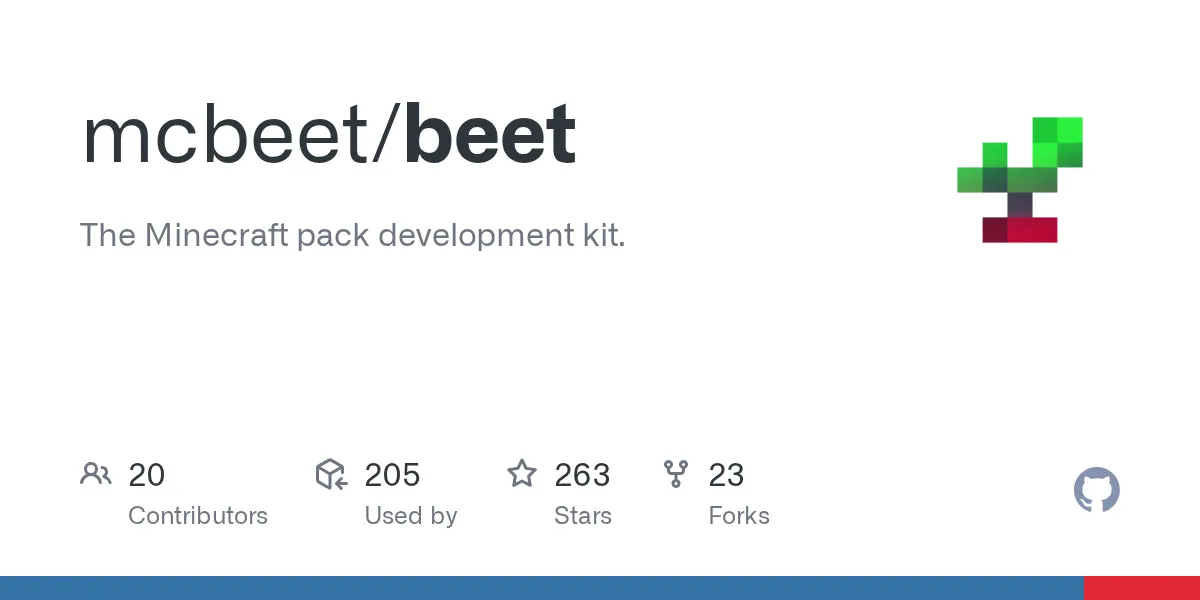
The Beet project (263 stars on GitHub, MIT licensed) has been actively developed and stays current with new Minecraft versions. That latest release, version 0.103.0 from March 2026, updated support for Minecraft 26.1. If you're concerned about the project being abandoned, it's not.
The community around Beet includes pack creators, tool developers, and collaborative project teams. If you're interested in creating custom content - whether that's skins like adderall_abuser's work, or complex gameplay systems - understanding how the ecosystem of pack development works helps you collaborate and share tools effectively.
Beet integrates with the broader Minecraft development community. Other tools and frameworks often output formats that Beet can consume, or Beet outputs can feed into other pipelines. You're not locked into an island.
When Beet Isn't the Answer
If you're making a simple texture pack and just want to swap some PNGs around, Beet is overkill. Grab a pack, edit the textures, repackage. Done in five minutes.
If you don't have Python installed and you're not willing to install it, Beet isn't happening. There are visual pack editors out there (though they've their own limitations).
If your workflow is deeply tied to existing GUI tools, Beet plays better with code-based workflows. You can integrate other tools, but Beet itself is CLI-driven.
Otherwise though, if you're building anything non-trivial, it's worth exploring.
Similar Tools Worth Knowing
The Minecraft modding and pack development community has other approaches. DataPacks.net has web-based generators for specific components, which work fine for targeted tasks. Some developers swear by MCFunction.js or similar JavaScript-based tools if they're already in that ecosystem. There's also raw file management in version control with nothing but git, which works if your team is small and discipline is high.
What Beet offers that most alternatives don't is a complete, unified framework. One configuration file, one pipeline, one way to compose plugins. If you're comparing specifically to hand-managing packs or using fragmented individual generators, Beet is a step up.
For collaborative pack development especially, Beet's approach to source control, testing, and reproducible builds is hard to beat. You get the benefits of software engineering practices applied to Minecraft.

Lead writer at minecraft.how. Long-time Minecraft player running a small SMP server, testing every build, mod, and seed before writing about it.
Frequently Asked Questions
Is Beet free to use?
What versions of Minecraft does Beet support?
Do I need to know Python to use Beet?
Can I convert my existing pack to Beet?
Does Beet work on Windows, Mac, and Linux?
Have a Question or Tip about this Guide?Community Q&A
Ask a question or help other players below. Join the discussion and share your Minecraft tips!