Minecraft Holy Client: Load Test Your Server
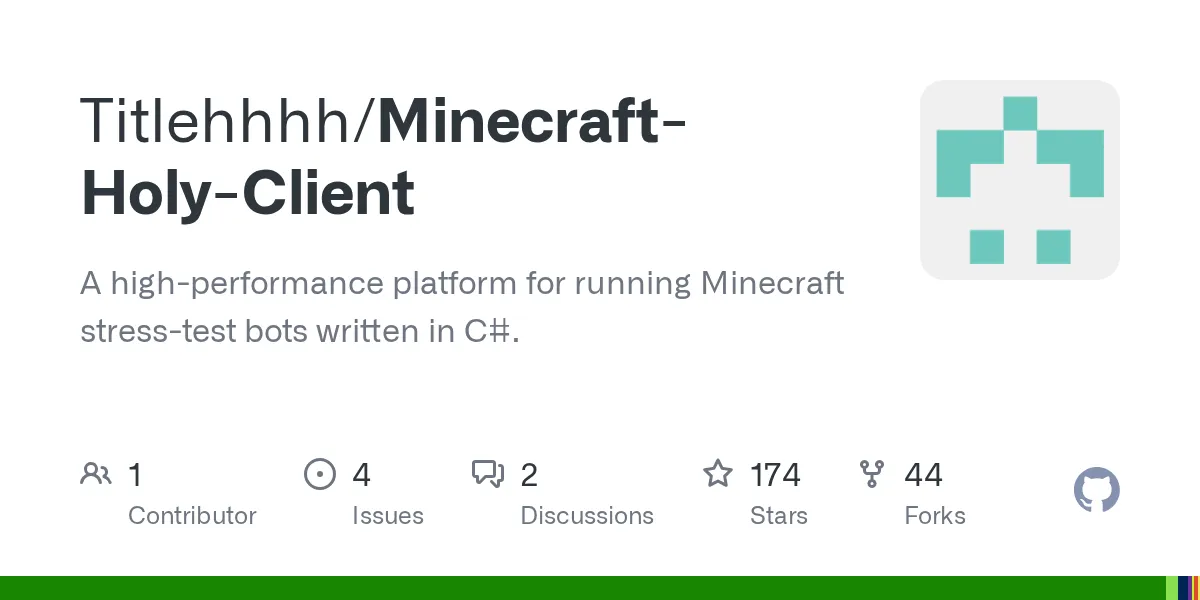
"A high-performance platform for running Minecraft stress-test bots written in C#."
Titlehhhh/Minecraft-Holy-Client · github.com
Ever wonder if your Minecraft server can actually handle a hundred players joining at once? Most server admins build infrastructure based on guesses, not data. Minecraft Holy Client solves that problem by letting you run hundreds of realistic bot players against your server to see where it breaks. It's written in C# for raw performance, and it'll run on weak hardware without choking.
What This Project Does
Minecraft Holy Client is a stress-testing framework, not a gameplay mod or client. You point it at your server, fire up hundreds of bots, and watch how your infrastructure responds under load. The bots connect, move around, place and break blocks, interact with NPCs, and generally behave like real players would.
The framework is open source (Apache-2.0) and has been downloaded and tested by over 174 people on GitHub who cared enough to star it. It's written in C#, which means it compiles to native code and runs lean on system resources.
Think of it as the difference between hoping your server stays up during a sale event versus knowing it'll.
Why You'd Use This
Server admins face a real problem: you don't know your breaking point until you hit it. You could spend money on servers you don't need, or skimp and cause downtime when players show up. Holy Client lets you find the truth.
Running 100 bots simultaneously isn't something you can test with manual play. You need tools designed for it. This framework handles the concurrency, the bot AI, and the network traffic all at once. It'll run on a single machine with modest specs, which is part of why the performance focus matters.
A few concrete scenarios where this matters:
- Before launching a new server, run bots to verify your host's hardware actually performs as advertised.
- After adding plugins or mods, stress test to make sure the server can still handle peak loads.
- When scaling up, test at your target player count first instead of finding out during actual gameplay.
- Monitoring plugins or performance optimizations need baseline measurements. This gives you that.
How to Get Started
Installation is straightforward. The project is portable and cross-platform (Windows, Linux, macOS), so you don't need to install anything to the system.
Head to the releases page and download the latest version. For Windows, extract the archive and run HolyClient.Desktop.exe. Linux users extract and follow platform-specific instructions in the README. That's it.
Configuration happens in the application itself, not through config files scattered around. Point it at your server address, set the number of bots you want to spawn, and run the test. The UI gives you real-time feedback on what the bots are doing and how your server responds.
If you're running a public server, you might also want to set up a free DNS for your Minecraft server or configure a nice MOTD message so players see what you're working on.
Key Features That Matter
Real bot behavior. The bots don't just sit idle or spam chat. They move, interact with the world, and generate realistic server load. This matters because a thousand idle connections won't tell you much, but a thousand bots actually playing will.
Performance first. The codebase was built to minimize CPU and memory overhead so the bots can run on modest hardware. You're not spinning up a cloud instance just to stress test. Run it on your development machine or a basic VPS.
Extensibility through plugins. If the default bot behavior doesn't match your needs (maybe you need bots to only interact with specific plugins), you can write custom bot logic. The framework is designed around this. One README mentions support for custom plugins, so you're not locked into the default behavior.
Multiple platform support. Windows, Linux, macOS. Run it on whatever machine you have available. Actually being portable (no system installation required) matters more than it sounds when you're jumping between test environments.
What Trips People Up
The project is no longer actively maintained, which the maintainer clearly states on the GitHub page. It was a foundation for experiments, not a permanent product. Before you build a workflow around it, understand that you're using a historical project. Updates and bug fixes probably won't come.
That said, for stress testing, you often don't need constant updates. If it works against your server version, it works. Just be aware of the limitation.
Another gotcha: stress testing requires planning. You can't just spawn 500 bots and expect useful results without thinking about what you're measuring. Set a baseline with a small number of bots first. Increase gradually. Watch where performance degrades. Random testing just wastes time.
Also, respect other people's servers. Only stress test servers you own or have explicit permission to test. This should be obvious, but it's worth stating clearly.
Other Tools for the Job
If you need something different, a few alternatives exist. Some server host control panels include built-in load testing tools, though they're usually limited. Custom bot frameworks written in Java can run Minecraft bot clients directly, but they tend to be heavier on resources. Some admins use Docker to spin up many client instances, which works but requires more infrastructure setup.
Holy Client sits in a sweet spot: it's open source, cross-platform, lightweight, and designed specifically for this job. The alternatives either cost money, require more setup, or are less efficient.

Lead writer at minecraft.how. Long-time Minecraft player running a small SMP server, testing every build, mod, and seed before writing about it.
Frequently Asked Questions
Is Minecraft Holy Client free to use?
What Minecraft versions does it support?
Can I use Holy Client to attack someone else's server?
How many bots can it actually run simultaneously?
Does the project still get updates?
Have a Question or Tip about this Guide?Community Q&A
Ask a question or help other players below. Join the discussion and share your Minecraft tips!