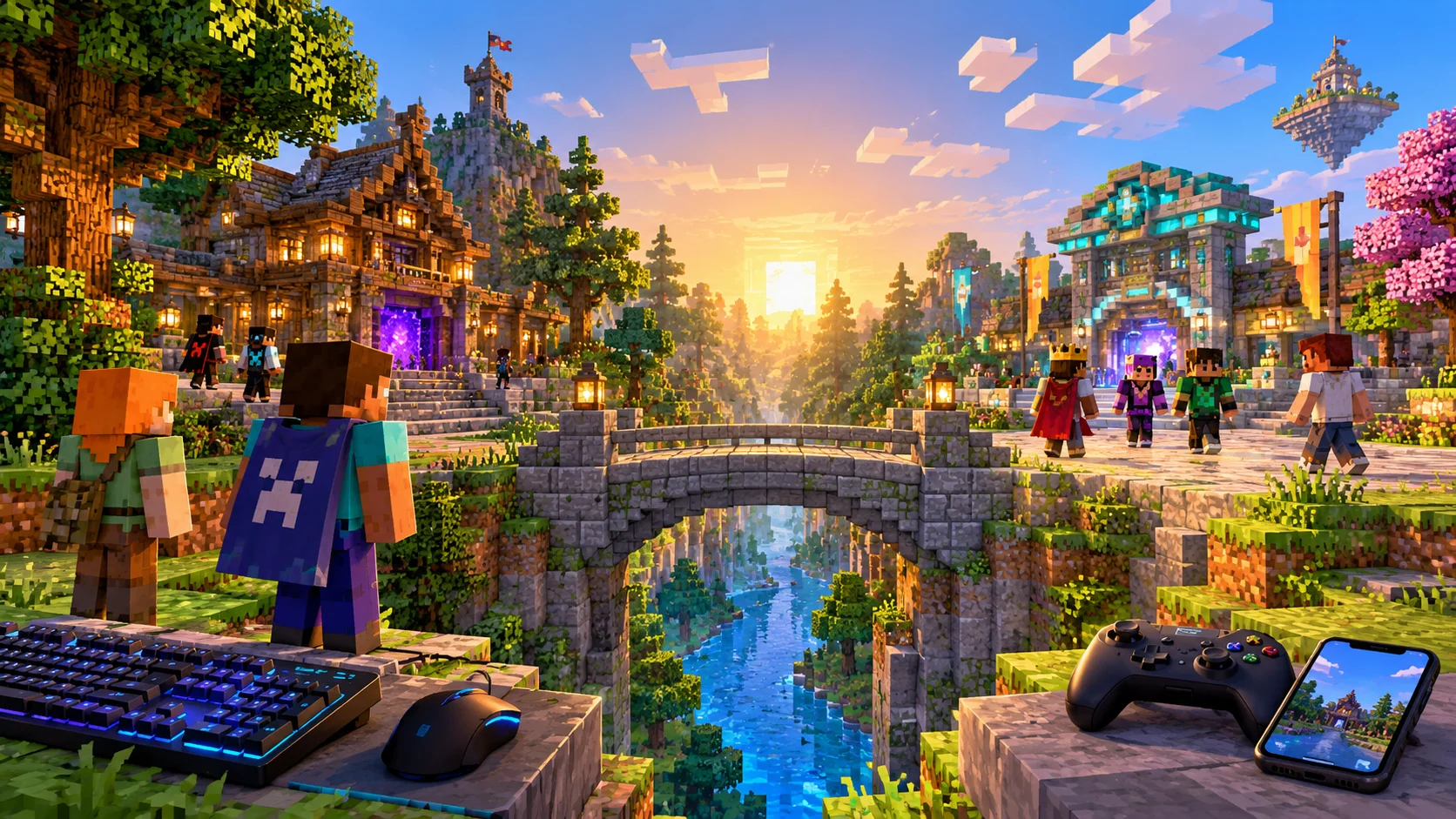

A Minecraft server can have an impressive plugin list, a custom spawn and a large number beside its name, yet still struggle to build a community. Players do not return simply because a server has more features. They return because they know what to do, feel welcome when they arrive, trust the people running the world and have a reason to keep playing.
Building a successful Minecraft server community is less about installing every popular plugin and more about creating a reliable experience around a clear idea. Whether you run a small SMP for friends or a larger network with several game modes, the same foundations matter: a defined identity, a smooth first session, fair rules, active moderation and communication players can rely on.
1. Give the server a clear identity
Before choosing plugins, decide what kind of community the server is meant to serve. A relaxed survival world, a competitive factions server, a creative building community and a minigame network attract different players. Trying to appeal to everyone can make the experience feel unfocused.
Write a short description that answers three questions: what do players do here, who is the server for, and what makes this experience different? Be specific. “Friendly survival with protected builds, player shops and regular community projects” tells a potential player more than “the best Minecraft server with everything.”
Keep the promise realistic. If the server is new, do not imply that it has a large active community. If a game mode is still being developed, label it clearly. Accurate descriptions attract players who actually want what the server offers, which is more valuable than a brief spike in visits from misleading promotion.
2. Make the first ten minutes easy
The first session often determines whether a new player gives the server another chance. A newcomer should quickly understand where they are, how to start playing and where to ask for help. Avoid forcing them through a long sequence of menus, announcements and commands before they can reach the main game.
- Use a short welcome: explain the server's main idea in plain language.
- Show the next step: make it obvious how to start survival, join a match or reach the main world.
- Explain essential rules: highlight the rules that affect immediate play, then link to the complete version.
- Provide help: show how to contact staff or use the support channel.
- Make progress visible: give newcomers a useful first objective without overwhelming them.
Test onboarding with someone who has never joined the server. Watch where they hesitate, what they ask and which instructions they miss. Fix those points before adding another plugin or tutorial screen.
3. Write rules players can understand and trust
Rules are not useful when they exist only as a long page that nobody reads. Players need to understand what is prohibited, what happens when a rule is broken and how they can appeal a decision. Keep the language direct and avoid vague statements such as “be respectful” without explaining how that applies to chat, harassment, threats, griefing or disruptive behaviour.
Separate global rules from game-mode rules. A survival world may need clear policies for stealing, PvP, land claims and inactive builds. A minigame network may need rules for teaming, exploits, match disruption and competitive conduct. Make the relevant rules visible where players need them.
Consistency matters more than severity. Similar situations should receive similar responses, regardless of whether the player is new, popular or a donor. Publish an appeal route and keep staff decisions focused on evidence and behaviour rather than personal disputes.
4. Build a moderation team, not just a staff list
Adding moderators does not automatically create effective moderation. Staff need defined responsibilities, access appropriate to their role and a shared process for handling reports. A small team that communicates and follows the same standards is usually more useful than a long list of inactive staff accounts.
Document how reports are received, how evidence is reviewed, when temporary restrictions are appropriate and who can handle appeals. Keep private player reports out of public arguments. When a case is resolved, explain the outcome to the people involved without exposing unnecessary personal information.
Moderation should also cover the spaces connected to the server, including Discord or other community channels. A player who is treated well in-game but ignored or harassed in the linked community is unlikely to feel that the server is a safe place to spend time.
5. Choose plugins for a reason
Plugins, mods, datapacks and Bedrock add-ons can improve a server, but every addition has a cost. It may introduce another configuration file, permission node, update dependency or possible conflict. Too many overlapping systems can make the server harder to maintain and harder for players to understand.
Start with the problems the server actually has. A protection plugin may be essential for a public survival world. A permissions system can help a growing staff team. A minigame network may need queue management and match statistics. A small private SMP may need very little beyond backups and basic administration.
Before installing anything, check that it supports the server software and game version you use. Review the project's documentation, update history and source. Test changes on a staging server or backup before deploying them to the live world. Remove systems that no longer serve a clear purpose.
6. Treat performance and reliability as community features
Players notice lag, repeated downtime, lost inventories and unexplained rollbacks far more than they notice many behind-the-scenes features. A dependable server is part of the community experience.
Monitor tick performance, memory use, storage and network stability. Investigate recurring lag instead of continually increasing hardware limits or removing random plugins. Schedule maintenance when it is least disruptive for the community and communicate expected downtime in advance.
Back up worlds and important configuration data on a schedule, and test that backups can actually be restored. A backup that has never been tested is not a recovery plan. Tell players what happens after a serious incident, especially if a rollback or world reset affects their builds.
7. Create reasons to return without turning play into a chore
Events give players a shared reason to meet, build and talk. They do not need to be elaborate. A community build project, a short parkour competition, a seasonal scavenger hunt or a player-run market day can create memorable moments with modest preparation.
Use events that fit the server's identity. A survival community may enjoy collaborative builds and exploration challenges, while a minigame network may benefit from tournaments and rotating maps. Give players enough notice, explain the rules and make participation optional where possible.
Long-term goals also help, but avoid making every activity depend on daily logins or endless grinding. Players have different schedules. A healthy community gives them ways to contribute at their own pace and still feel that their progress matters.
8. Listen to players and measure the right things
Feedback is most useful when players can see that it leads to thoughtful decisions. Provide a clear place for suggestions and bug reports, acknowledge useful reports and explain why a popular request may not fit the server. Do not promise every feature that receives votes.
Look beyond the peak online count. Track how many new players return, how long it takes them to reach the main gameplay, which modes they use, how often they encounter errors and whether reports are resolved. A network with many players in one lobby can still have an inactive survival mode or empty minigame queues.
Ask focused questions after updates and compare behaviour over time. A small number of returning players who enjoy the experience is a stronger foundation than a large one-time promotion that brings people who never come back.
9. Be honest about Java, Bedrock and crossplay
Edition support is part of the promise a server makes to its players. Java Edition and Bedrock Edition use different multiplayer systems and do not connect to each other natively. Some community servers support both through compatibility software such as Geyser, but owners must configure and test that setup rather than assume crossplay will work automatically.
Publish the supported editions, game versions and connection instructions clearly. If Bedrock players can join through a bridge, explain any limitations they may encounter. Test permissions, chat, inventory behaviour and gameplay features with real clients from each supported platform. Official Minecraft guidance explains that Java and Bedrock players need matching editions to join ordinary hosted games.
Players looking for a community can explore the Minecraft.How server directory. Check each listing's edition, version, rules and activity, then verify connection details with the server itself before joining. For more context, see our guide to Minecraft server communities and their different play styles.
10. Grow at a pace the team can support
Promotion can bring new players, but growth exposes weaknesses. If staff cannot handle reports, onboarding is confusing or the server struggles under load, a larger audience can make the experience worse. Improve the foundations before investing heavily in advertising, partnerships or additional game modes.
Keep a simple operating routine: review reports, check performance, confirm backups, publish useful updates and ask players what is getting in their way. Assign responsibility for each task so that essential work does not depend on one person remembering everything.
For readers interested in gaming coverage beyond Minecraft, GoldCrit covers the wider PC gaming scene alongside the topics explored here.
A successful Minecraft server community is not defined by the number of plugins installed or the highest player count it has ever reached. It is defined by whether players understand the experience, trust the people running it and want to return. Build those foundations first, and new features will have a community worth serving.
Minecraft.How is an independent Minecraft resource and is not affiliated with Mojang or Microsoft.