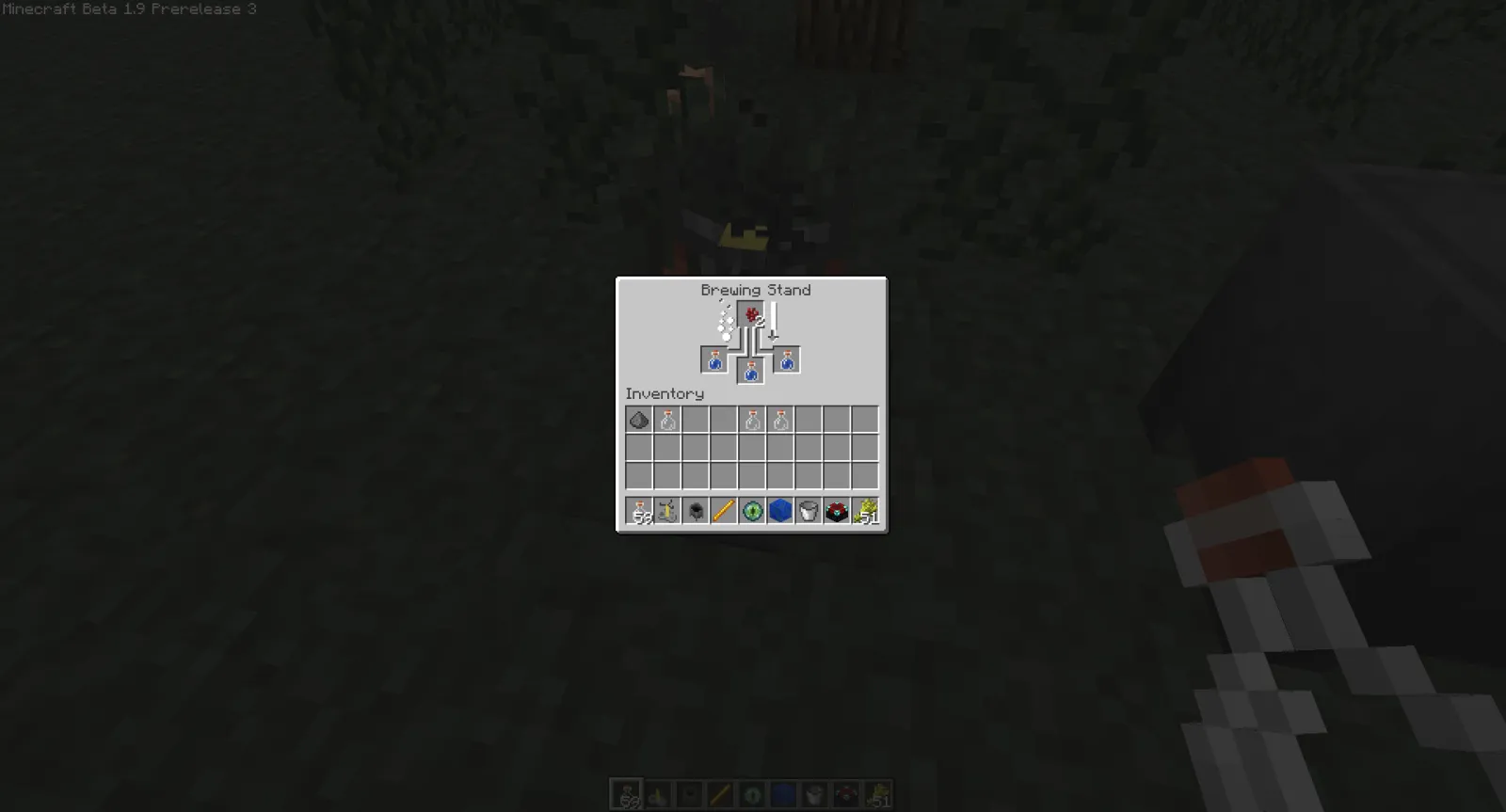

Quick answer: To brew most Minecraft potions, fuel a brewing stand with Blaze Powder, place up to three water bottles in the bottom slots, and brew Nether Wart into Awkward Potions. Then add the ingredient for the effect you want. For example, Magma Cream makes Fire Resistance, Glistering Melon Slice makes Healing, and Ghast Tear makes Regeneration. Redstone extends eligible potion durations; it does not create Fire Resistance.
What you need for potion brewing
Craft a brewing stand from one Blaze Rod and three cobblestone or compatible stone-tier blocks, or locate one already placed in the game. Bring glass bottles, water, Blaze Powder for fuel, and Nether Wart from Nether fortresses or bastion-related loot and farming. Place fuel in the brewing stand's fuel slot, bottles in the three lower slots and one reagent in the upper slot. Each brewing operation takes about 20 seconds and may process up to three bottles at once.
For most effect recipes, begin with water bottles and Nether Wart to produce Awkward Potions. The main exception is Weakness: brewing Fermented Spider Eye into a water bottle is a valid way to make it without Nether Wart. Ordinary potions and their splash and lingering variants use distinct bottle forms.
Minecraft potion recipes: complete ingredient table
The table below shows the base ingredient placed into an Awkward Potion unless the row specifically says otherwise. These are standard vanilla brewing paths, not special recipes added in 26.2.
| Potion / effect | Ingredient or brewing path | Practical use |
|---|---|---|
| Fire Resistance | Magma Cream | Surviving lava and fire in the Nether |
| Healing (Instant Health) | Glistering Melon Slice | Instant recovery after combat |
| Regeneration | Ghast Tear | Gradual health recovery |
| Strength | Blaze Powder | Higher melee damage |
| Swiftness | Sugar | Faster movement |
| Leaping | Rabbit's Foot | Higher jumps |
| Night Vision | Golden Carrot | Seeing in darkness |
| Water Breathing | Pufferfish | Underwater exploration |
| Slow Falling | Phantom Membrane | Reducing fall danger |
| Poison | Spider Eye | Damage over time to affected targets |
| Turtle Master | Turtle Shell | Resistance at the cost of movement speed |
| Invisibility | Night Vision + Fermented Spider Eye | Concealment, with important armor limitations |
| Slowness | Swiftness or Leaping + Fermented Spider Eye | Reducing target mobility |
| Harming (Instant Damage) | Healing or Poison + Fermented Spider Eye | Instant damage to living targets |
| Weakness | Water Bottle + Fermented Spider Eye | Lower melee damage; curing zombie villagers |
| Oozing | Slime Block | Spawns slimes when an affected entity dies |
| Weaving | Cobweb | Spawns cobwebs when an affected entity dies |
| Infestation | Stone | Chance to spawn silverfish when struck |
| Wind Charging | Breeze Rod | Wind burst upon affected entity death |
For precise durations, amplified levels and edition-specific exceptions, refer to the Minecraft Wiki brewing reference. Some versions or modified servers use datapacks that alter the available recipes.
How to extend, strengthen or change a potion
- Redstone Dust: extends the duration of compatible timed potions, including Night Vision and Fire Resistance. It is a modifier, not the ingredient that creates the primary effect.
- Glowstone Dust: upgrades the strength of supported potions, such as Healing II, usually at the expense of duration where applicable.
- Fermented Spider Eye: changes specific existing recipes, such as Night Vision to Invisibility and Healing to Harming. It is not a direct universal recipe for every negative effect.
- Gunpowder: converts an ordinary potion into a throwable Splash Potion.
- Dragon's Breath: turns a Splash Potion into a Lingering Potion, which leaves an area-effect cloud.
Not every potion accepts every modifier. You generally cannot combine an extended and an enhanced form of the same potion. Check the item name in the brewing stand before consuming rare ingredients.
Five beginner recipes worth learning
- Fire Resistance: Water Bottle → Nether Wart → Magma Cream. For many Nether expeditions, extend it with Redstone.
- Healing: Water Bottle → Nether Wart → Glistering Melon Slice. Add Glowstone Dust to obtain the stronger healing variant.
- Night Vision: Water Bottle → Nether Wart → Golden Carrot. Use Redstone if you need a longer exploration session.
- Slow Falling: Water Bottle → Nether Wart → Phantom Membrane. Valuable for dangerous heights and End exploration.
- Weakness Splash: Water Bottle → Fermented Spider Eye → Gunpowder. Use it with a Golden Apple when curing a Zombie Villager.
Java vs. Bedrock: what differs?
The central brewing workflow is shared across modern Java and Bedrock editions. Differences exist in edge-case recipe behavior, platform menus and some effect interactions. Do not assume datapacks on a Java server change Bedrock's recipes in the same way. In Java 26.3, brewing recipes became data-driven, allowing compatible datapacks to define recipe changes; that is a customization feature, not proof that Mojang changed standard Fire Resistance or Healing ingredients. See the official Java 26.3 notes.
Brewing tips for survival and PvP
Make three bottles at a time when you have enough supplies, because one brewing operation can process all three slots. Farm Nether Wart near a safe base, keep Blaze Powder stocked, and label storage by ingredient or effect. Reserve Fire Resistance for Nether exploration, Healing for emergency combat, and Night Vision and Water Breathing for long underwater searches. Splash versions are useful for quick applications to yourself or teammates; avoid throwing harmful potions into allied players.
For multiplayer players, check Minecraft creative servers if you want to practice potion effects without losing survival resources. Custom server plugins may change combat balance and permitted effects, so always test actual behavior in that environment.
Why is my brewing stand not working?
First check that Blaze Powder fuel is present and the bottles are in the bottom slots. Next confirm that you started from the correct base potion: most effects need Awkward Potion, not plain water. If an ingredient does nothing, the potion may already be extended, enhanced, or incompatible with that reagent. On modded servers, confirm whether a datapack or plugin has changed the recipe. The brewing interface should display the result after the brew completes.
Fact-check sources: Minecraft's official Healing Potion tutorial; official Splash Potion guide; Minecraft Wiki brewing recipes; Minecraft Java 26.3 release notes.