
A Minecraft resource pack is supposed to change how a world looks and sounds. A newly published proof of concept called Minecraft2Shell demonstrates why players should also treat unfamiliar packs as software they are choosing to load. Under a specific set of conditions, a crafted font inside a server-delivered resource pack can exploit the native font-rendering library used by Minecraft: Java Edition and execute code on a Windows computer.
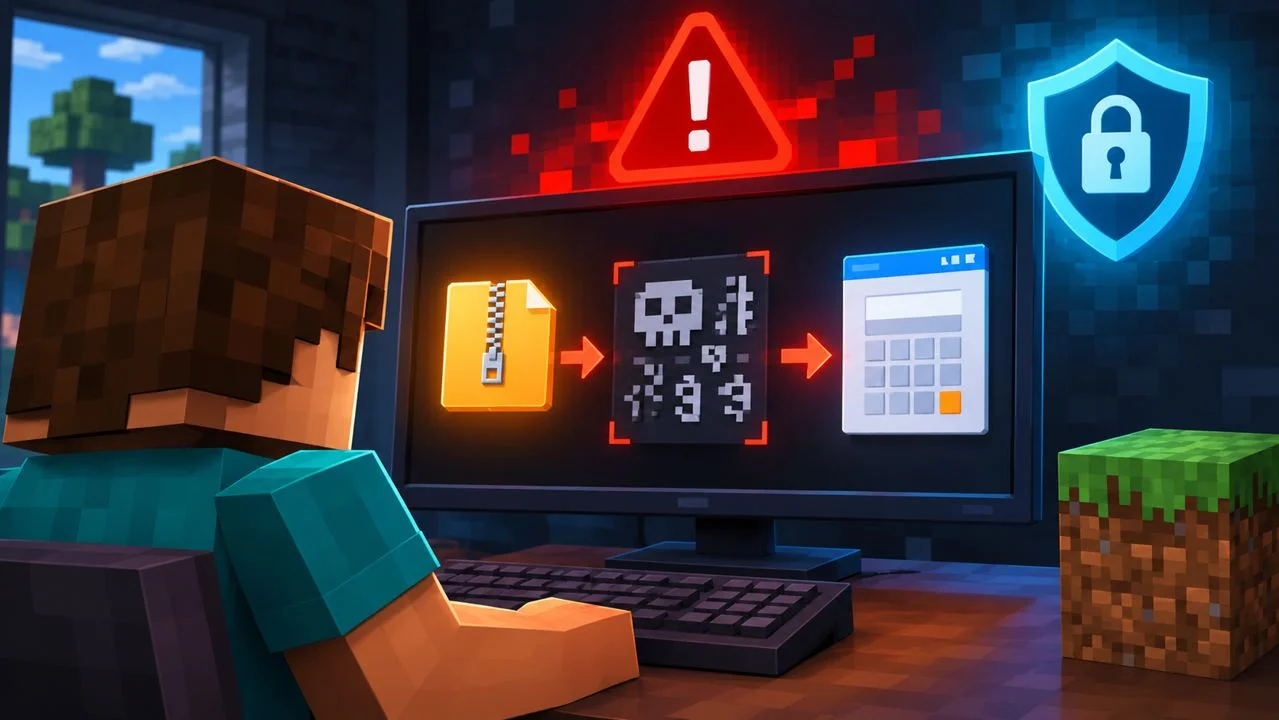
The public demonstration was published by GitHub user bikini and targets the Mojang-signed Minecraft Java 26.3 client on Windows x64. It launches Windows Calculator as proof that code execution was achieved. That is a demonstration payload, not evidence that Calculator itself is the threat: the underlying issue is the ability to make the client execute native code.
What is Minecraft2Shell?
Minecraft2Shell is a proof-of-concept exploit chain involving TrueType fonts and FreeType, the native library Minecraft uses to process certain fonts supplied by resource packs. The important detail is that this is not a conventional Java-only bug. The crafted font reaches native code that processes font outlines and hinting instructions, putting the vulnerability outside the normal protections of the Java virtual machine.
According to the public repository, the demonstrated chain uses a malformed composite glyph to trigger an out-of-bounds write in FreeType's TrueType interpreter. Carefully constructed font instructions then turn that memory corruption into a control-flow transfer. In the tested build, the final chain calls Windows APIs and starts calc.exe.
How can a resource pack trigger it?
The attack begins with a server supplying a resource pack that contains specially crafted TrueType fonts. When the client loads the pack and later renders selected text, the font engine processes glyphs and executes the font's hinting bytecode. The proof of concept uses ordinary actionbar messages to make the client process particular glyphs.
The repository's demonstration includes many font variants to improve the chance of obtaining the memory layout required by its exploit. This is a build-specific technique, not a universal exploit that has been shown to work unchanged on every Minecraft version or operating system.
There is an important user-action detail: the published demonstration does not bypass Minecraft's normal resource-pack consent prompt. A player may nevertheless have packs loaded automatically if they previously trusted a server or configured that server's resource-pack setting to Enabled. Accepting a pack from an untrusted server can therefore expose the client to the malicious font.
Which Minecraft versions are confirmed?
The strongest confirmed result is narrow: the public proof of concept demonstrates code execution against Minecraft Java 26.3 on Windows x64, using the bundled FreeType 2.14.3 build. Reports discussing the underlying library bug identify other potentially affected versions, but the exact proof of concept has not been demonstrated across all of them.
- Minecraft Java 26.3: the public proof of concept is reported to work on Windows x64.
- 26.4 snapshots using FreeType 2.14.3: reporting indicates the same exploit chain has also been demonstrated on relevant snapshots; check the specific build before drawing conclusions.
- 26.1–26.2 and older releases from 1.20.5 onward: the underlying FreeType issue may be present in bundled versions, but the published 26.3 exploit is not proof that the same payload works on these builds.
- 1.20.4 and older: the available reporting says these versions use a different font implementation, so this particular FreeType attack path does not apply.
Do not interpret an unconfirmed build as definitely safe. The exploit author's offsets and gadgets are tied to a particular native binary, while the underlying bug may exist in other FreeType versions too.
Has it been fixed?
The upstream FreeType project fixed the relevant issue in FreeType 2.15.0. However, Minecraft ships its own bundled build, so an upstream FreeType release does not automatically update installed Minecraft clients. At the time of writing, November 25, 2026, the public reporting reviewed for this article had not established that Mojang had shipped a Minecraft update containing the fix.
Players should check the official Minecraft Launcher and release notes for a security update rather than assuming that changing a resource pack or updating a separate system library will patch the bundled client. We will update this article when Mojang confirms a fix and identifies the affected releases.
What should players and server owners do?
- Disable automatic server resource packs for servers you do not fully trust. In the Multiplayer server list, edit the server and set Server Resource Packs to Disabled.
- Decline unexpected resource packs from unfamiliar servers. A server may refuse entry if its pack is required, but declining is safer than loading an unknown pack while this issue remains unresolved.
- Do not manually install packs from untrusted sources. The risk is not limited to a pack delivered by a server; manually loading a malicious font can also put the vulnerable font-processing path in play.
- Keep Minecraft updated and watch official release notes for a fix that updates the bundled FreeType library.
- Server administrators should review forced-pack settings. Avoid requiring players to load packs unless they are necessary, maintained, and obtained from a trusted source. Tell your community why a pack is required and where it comes from.
An unofficial community workaround named minecraft2shell-fix has also been reported. It aims to disable the relevant TrueType hinting path through a mod or Java agent. It is not an official Mojang patch, and players should evaluate its source, compatibility, and trustworthiness before installing third-party code.
Why this matters beyond one Minecraft version
Minecraft2Shell is a reminder that resource packs are not always just collections of harmless images and sounds. Modern games process complex file formats using native libraries, and a bug in one of those libraries can cross the boundary from game content into the host operating system. The same general lesson applies to fonts, media codecs, document parsers, and other components that process data from outside sources.
For now, the practical response is straightforward: do not automatically trust resource packs from servers you do not know, keep the client updated, and wait for an official Minecraft fix. The public proof of concept is serious, but its demonstrated scope should be described accurately rather than assuming every Java version is equally exploitable.