
Calcite is a pale, textured building block in Minecraft that players can collect from amethyst geodes and Stony Peaks. In the upcoming Minecraft 26.4 update, it becomes much more useful for builders: Java Snapshot 7 adds Calcite Pillars, Slabs, Stairs and Walls, plus Polished Calcite and Polished Calcite Bricks block sets. The new variants are still preview content, so their recipes and availability may change before the stable release.
Where to find Calcite in Minecraft
There are three useful places to look, depending on the game version you are playing:
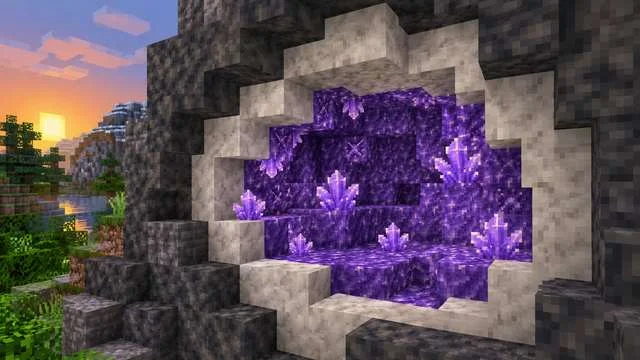
- Amethyst geodes: Calcite forms the middle shell between the outer Smooth Basalt layer and the inner amethyst blocks. Explore caves and underground openings, and look for the rounded geode structure. A visible crack can make the pale layer easier to spot.
- Stony Peaks: Calcite can appear in pale strips through the stone of this mountain biome. Search exposed slopes and cliff faces while travelling across high terrain.
- Ice Caves (26.4 test versions): The new Ice Caves biome introduced in the 26.4 snapshot series contains large areas of Packed Ice and Calcite. It generates underground beneath colder Overworld biomes. This location is version-dependent and should not be assumed to exist in older stable worlds.
Amethyst geodes are not restricted to one biome. They generate underground in the Overworld, so exploring cave systems is more reliable than searching only in a Deep Dark or Lush Caves biome. Those two biomes are not Calcite's normal generation locations.
How to mine Calcite and collect it safely
Use any pickaxe to mine Calcite. A wooden pickaxe is enough, so you do not need iron, diamond, Netherite or Silk Touch. Breaking the block with your hand or an unsuitable tool does not drop Calcite. The block has a hardness of 0.75 and a blast resistance of 0.75, making it quick to collect but not a defensive building material.
When exploring an amethyst geode, remember that the Calcite shell is separate from the budding amethyst blocks inside. Budding Amethyst is important because it grows new crystals; do not break it if you want the geode to keep producing amethyst buds and clusters. Take the Calcite around it without damaging the blocks you want to preserve.
If you are playing an older world, new natural deposits appear only in newly generated terrain. Travel beyond explored chunks to search for geodes, Stony Peaks or the new Ice Caves when your version supports them.
New Calcite blocks in Minecraft 26.4 Snapshot 7
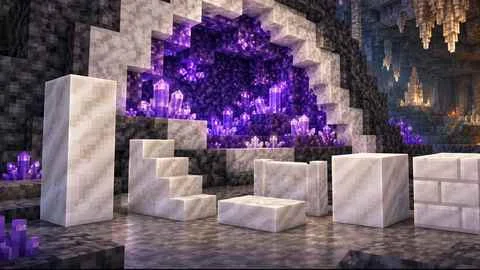
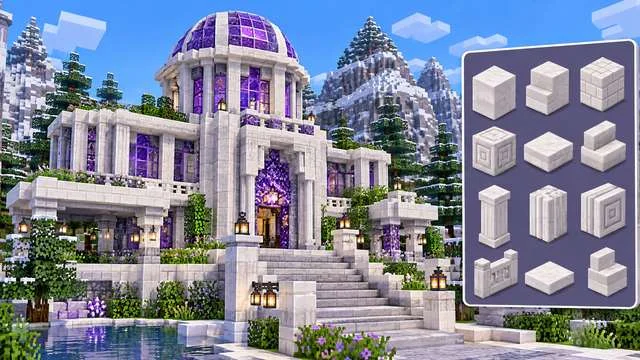
The biggest change for builders is the new Calcite block family. Minecraft Java 26.4 Snapshot 7, published on November 3, 2026, adds three related sets:
- Calcite: the original block, plus Pillar, Slab, Stair and Wall variants.
- Polished Calcite: a cleaner finish made from a 2-by-2 arrangement of Calcite, with matching Slab, Stair and Wall options.
- Polished Calcite Bricks: a brick-textured finish made from a 2-by-2 arrangement of Polished Calcite, with matching Slabs, Stairs and Walls.
The Stonecutter supports the new building variants and is the most flexible way to turn a supply of Calcite into the shape you need. The basic block recipes are straightforward: place four Calcite blocks in a 2-by-2 square to make four Polished Calcite, then place four Polished Calcite in a 2-by-2 square to make four Polished Calcite Bricks. Check the in-game recipe book in your snapshot or preview build, because test-version recipes can still be adjusted.
Best building ideas for Calcite
Calcite's cool, pale tone works well as a main surface or a contrast material. Use regular Calcite for natural cave walls, bright floors and soft transitions between darker stone. Polished Calcite suits modern bases, laboratories, snowy villages and clean interior walls. Polished Calcite Bricks add more visible texture to columns, entrances and large exterior walls.
Try combining the new variants with Smooth Basalt for dark borders, Amethyst Blocks for purple highlights, Packed Ice for a cold palette, or Deepslate for strong contrast. Pillars can frame doorways and support rooflines; slabs and stairs help you avoid flat, box-shaped builds; walls are useful for retaining edges and raised walkways. Because the variants share a related colour palette, you can mix them without making a build look visually noisy.
Calcite and Sulfur Cubes
In the 26.4 Snapshot 7 notes, Calcite, Polished Calcite and Polished Calcite Bricks are assigned to the Slow Bouncy Sulfur Cube archetype. This is a specific interaction in the new test content, not a general crafting or combat ability. If you are experimenting with Sulfur Cubes, test the full blocks rather than assuming every slab, stair or wall has the same behaviour.
Is Calcite available in Java and Bedrock?
Calcite has been part of vanilla Minecraft since the Caves & Cliffs era and is available in both Java and Bedrock. The expanded block set is being tested in Java 26.4 Snapshot 7 and Bedrock Preview 26.70.23 as of November 3, 2026. These are test builds, not a guarantee that every player on the current stable release can craft the new variants. Back up your world before opening it in a snapshot or preview version, and use a separate test world where possible.
For a closer look at the new cold underground biome, read our Minecraft 26.4 Ice Caves survival guide. The official Minecraft 26.4 Snapshot 7 notes list the Calcite block set and its test-version changes.
Quick facts
- Block ID:
minecraft:calcite. - Mining tool: any pickaxe; no Silk Touch required.
- Natural locations: amethyst geodes and Stony Peaks; Ice Caves in 26.4 test versions.
- Primary use: decoration and building.
- Stack size: 64.
- New 26.4 variants: Calcite Pillar, Slab, Stair, Wall, Polished Calcite and Polished Calcite Bricks sets.
Calcite is no longer just a pale block you collect while hunting for amethyst. With the expanded 26.4 block sets, it can form a complete building palette for modern architecture, mountain bases, crystal halls and winter-themed builds. Find it in geodes or mountain terrain, bring a pickaxe, and try the new shapes in a backed-up snapshot world before using them in a long-running survival save.