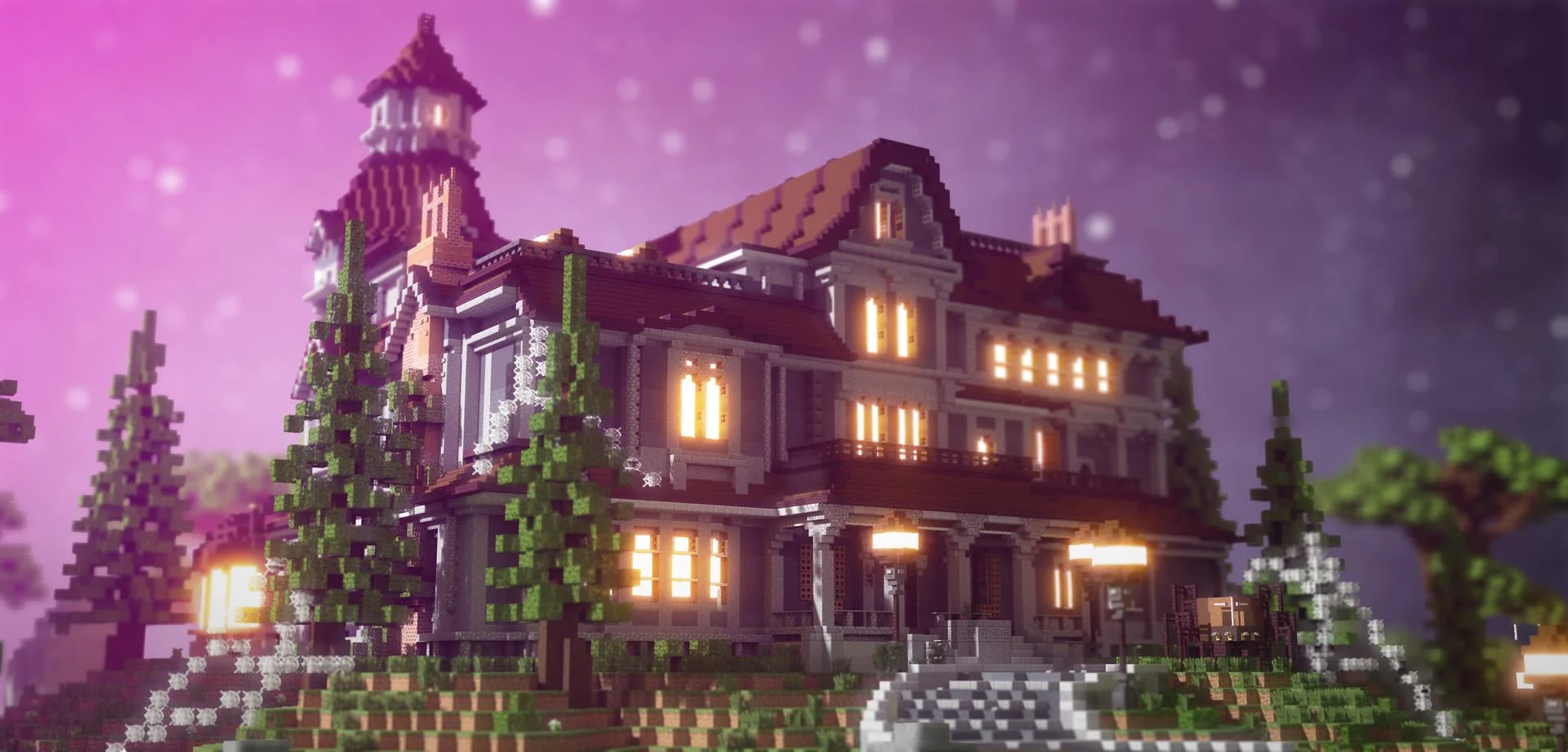

A Minecraft haunted house does not need hundreds of rooms or a giant block palette to feel unsettling. The strongest Halloween builds use a clear silhouette, an overgrown entrance, uneven lighting and a few carefully placed details that make players curious about what is inside. This guide walks through a practical haunted-house design that works in Survival or Creative mode and can be adapted for Java Edition and Bedrock Edition.
Plan the haunted house before placing blocks
Start with a footprint of roughly 17 by 23 blocks and leave extra space for a crooked garden, a path and a small graveyard. Choose a location that supports the mood: the edge of a dark forest, a hill above a swamp, or an isolated patch of woodland. A slight slope is useful because it lets the house sit above the path and look more imposing.
Sketch the shape before building. A simple main rectangle with a narrower side wing and a two- or three-storey tower looks more convincing than a plain box. Avoid making both sides perfectly symmetrical. Push one wing forward by two blocks, make the tower slightly taller than the main roof, and add a small porch to break up the front wall.
Choose a spooky block palette
Use a limited palette so the house looks intentional rather than noisy. Dark oak or spruce logs make a strong timber frame. Deepslate bricks, stone bricks and cobblestone work well for the foundation and roof. Add cracked or mossy stone bricks around the lower walls to suggest age. Spruce or dark oak stairs and slabs create steep roof lines, while trapdoors add shutters and timber details.
- Structure: dark oak or spruce logs, planks and stairs.
- Foundation: stone bricks, cobblestone, andesite or deepslate bricks.
- Roof: deepslate tiles, spruce stairs and slabs.
- Windows: tinted or grey stained glass panes, with a few broken-looking gaps.
- Decoration: cobwebs, chains, lanterns, candles, barrels, leaves and carved pumpkins.
You do not need every block in the list. If you are playing Survival, substitute materials you can gather easily. A spruce-and-cobblestone version can look just as atmospheric as a build using rare blocks.
Build the foundation and uneven walls
Mark the footprint with temporary blocks, then raise the foundation one or two blocks above the surrounding ground. Use stone and deepslate variants together, but keep the darkest blocks near the corners and underneath the porch. This creates depth and makes the building look older.
Build the main walls about six blocks high for the ground floor. Place vertical logs at the corners and every four or five blocks along the walls, then fill the spaces with planks or stone. Add a side wing that is one block lower and a tower at the opposite corner that rises another five or six blocks. A small change in height makes the silhouette much more interesting from a distance.
Add steep roofs, gables and a crooked tower
Use stairs and slabs to make a steep roof rather than a flat lid. Extend the roof one block beyond the walls to create an overhang. At the front and back, build triangular gables with stair blocks and fill the centre with planks, logs or dark stone. A narrow tower can use a taller pointed roof, with fences or walls as a small finial.
For a deliberately neglected look, vary the roofline slightly: add a short dormer, leave one corner lower, or use a different stair material on the side wing. Keep the main roof shape readable, though. Too many random changes make the house look unfinished instead of haunted.
Make the windows and entrance tell a story
Use narrow windows on the upper floors and larger windows near the entrance. Dark stained glass gives the rooms a shadowy appearance, while warm light behind a few panes suggests that something is still inside. Do not illuminate every window equally. Leave some rooms dark and place lanterns or candles in only selected spaces.
Build a short staircase to a recessed front door. Frame it with logs, stone-brick stairs and two lanterns hanging from chains. Add trapdoors as shutters, vines or leaves around the frame, and a sign or banner to identify the house. A broken fence, a tipped-over flower pot or a patch of coarse dirt can make the approach feel abandoned.
Decorate the garden, graveyard and path
The area around the house is what turns a dark building into a Halloween scene. Create a winding path using coarse dirt, gravel, rooted dirt and stone buttons. Avoid a perfectly straight walkway. Place carved pumpkins and jack o'lanterns at irregular intervals, mixing them with lanterns so the light has different heights.
For a tiny graveyard, use stone-brick walls, stairs and slabs to create varied tombstones. Add signs with fictional names, dead bushes, cobwebs and a few wither roses if you want a more dangerous atmosphere. Keep the graveyard small enough that the mansion remains the focal point. A dead tree made from stripped logs and fences can fill an empty corner without using many blocks.
Furnish the inside with small scenes
Give each room a purpose instead of filling every floor with random furniture. The ground floor could contain a dusty hall, dining room and library. Use barrels as cabinets, stairs as chairs, trapdoors as tables, and chains or lanterns as hanging lights. A brewing stand, cauldron and bookshelves can suggest that the owner was experimenting with potions.
Put the most memorable detail in one room: a sealed cellar entrance, a hidden chest behind a bookshelf, an armour stand in an empty bedroom, or a narrow staircase leading to the tower. These details create a reason to explore the build. In multiplayer, you can hide a small reward or a written clue for visitors.
Lighting and atmosphere without losing visibility
Halloween builds look better with contrast, but players still need to navigate safely. Use lanterns, candles and jack o'lanterns to guide the main route. Keep decorative shadows in corners and behind furniture, but light stairs, doors and narrow corridors enough to avoid frustrating falls. If you are building a survival base, check hostile mob spawning and light every area that must remain safe.
For a final pass, view the house from the path at night and again during the day. At night, the windows and lanterns should guide the eye to the entrance. In daylight, the roof shape, tower and block palette should still read clearly. Add or remove decorations until the build looks coherent from both viewpoints.
Make it a Halloween attraction for your server
On a multiplayer server, turn the house into a short exploration challenge. Give visitors a route through the garden, hall, library and cellar, then hide three clues that reveal a code or the location of a reward chest. Use signs to explain the rules and keep the route accessible for new players. You can also host a building contest where players create a smaller haunted house using the same block palette.
The best Minecraft haunted house is not necessarily the largest. A strong silhouette, a consistent palette, selective lighting and a few memorable interior scenes will make a compact build feel more convincing. Start with the structure, add the garden and lighting, then finish with details that reward players who take the time to explore.
Further inspiration
For another take on a Victorian-style Halloween mansion, see this haunted mansion build tutorial. Use it as visual inspiration and adapt the shape and materials to your own world.