DreamerV3: How Machine Learning Learns to Master Minecraft
dreamerv3 (danijar/dreamerv3)
Mastering Diverse Domains through World Models
Want to see what happens when you give an AI agent a Minecraft-like world and zero explicit instructions? DreamerV3 is a research framework that trains agents to build internal models of how games work, then uses those models to make smart decisions. It's not for casual players, but if you're curious about where game AI research is headed - or if you've ever wondered how machine learning could tackle open-ended problems like Minecraft - this is worth understanding.
What DreamerV3 Does
DreamerV3 is a Python-based reinforcement learning framework built on JAX. At its core, it does something kind of counterintuitive: instead of training an agent to play directly, it first teaches the agent to predict what will happen next.
Think of it this way. A skilled Minecraft player doesn't memorize every possible situation. They understand cause-and-effect: wood burns in furnaces, stone requires a pickaxe, water flows downhill. Most build a mental model of the world's rules, then use that model to plan ahead. DreamerV3 tries to replicate that process in code - it watches itself play, learns patterns about how the environment responds to actions, and builds an internal world model. Once it understands the rules, it trains a separate controller to make smart decisions based on that model.
The technical details matter if you're implementing this. But this framework encodes observations into categorical distributions (not continuous vectors), predicts future states and rewards given actions, and trains both the world model and the policy from imagined trajectories. But the intuition is simpler: learn how the world works, then use that knowledge to win.
The Minecraft Connection
Here's where I need to be honest. DreamerV3 isn't a Minecraft mod. It's not something you download and play with. But the project is commonly tested on Crafter, which is essentially a procedurally-generated 2D Minecraft-inspired environment - complete with crafting, resource gathering, survival mechanics, and exploration. It's how researchers validate that their algorithms work on the kinds of open-ended problems Minecraft represents.
Some people in the research community have also experimented with plugging actual Minecraft Java Edition into DreamerV3 using the game's API, though that's not officially supported. Honestly, the repository itself (3,209 GitHub stars) includes standard configs for various environments, with Crafter as one of the main testing grounds.
Why care? DreamerV3 represents the frontier of how we're thinking about teaching machines to play and explore open worlds. That's worth paying attention to if you care about where game AI is headed.
Setting It Up (and What You'll Need)
Reality check first: you'll need Python 3.11 or newer, a GPU (or weeks of patience on CPU), and genuine comfort reading research code. So this isn't a game modification or a tool that runs in the background. It's a full research framework.
Installation starts with JAX and dependencies:
pip install -U -r requirements.txtAfter dependencies are installed, training a model looks like this:
python dreamerv3/main.py \ --logdir ~/logdir/dreamer/{timestamp} \ --configs crafter \ --run.train_ratio 32That trains an agent on Crafter. The `train_ratio` parameter is important - it controls how many imagined steps the agent takes for each real interaction with the environment. Higher values mean faster learning but more computation.
One gotcha: if you see a "Too many leaves for PyTreeDef" error during training, you're probably reloading the model incorrectly in the training script. Check the weight loading logic.
What Makes This Different
Most reinforcement learning algorithms require hours of hyperparameter tuning for each new environment. You train on Atari? One set of settings. Train on robotics? Different settings. Train on Crafter? Different again. It's tedious.
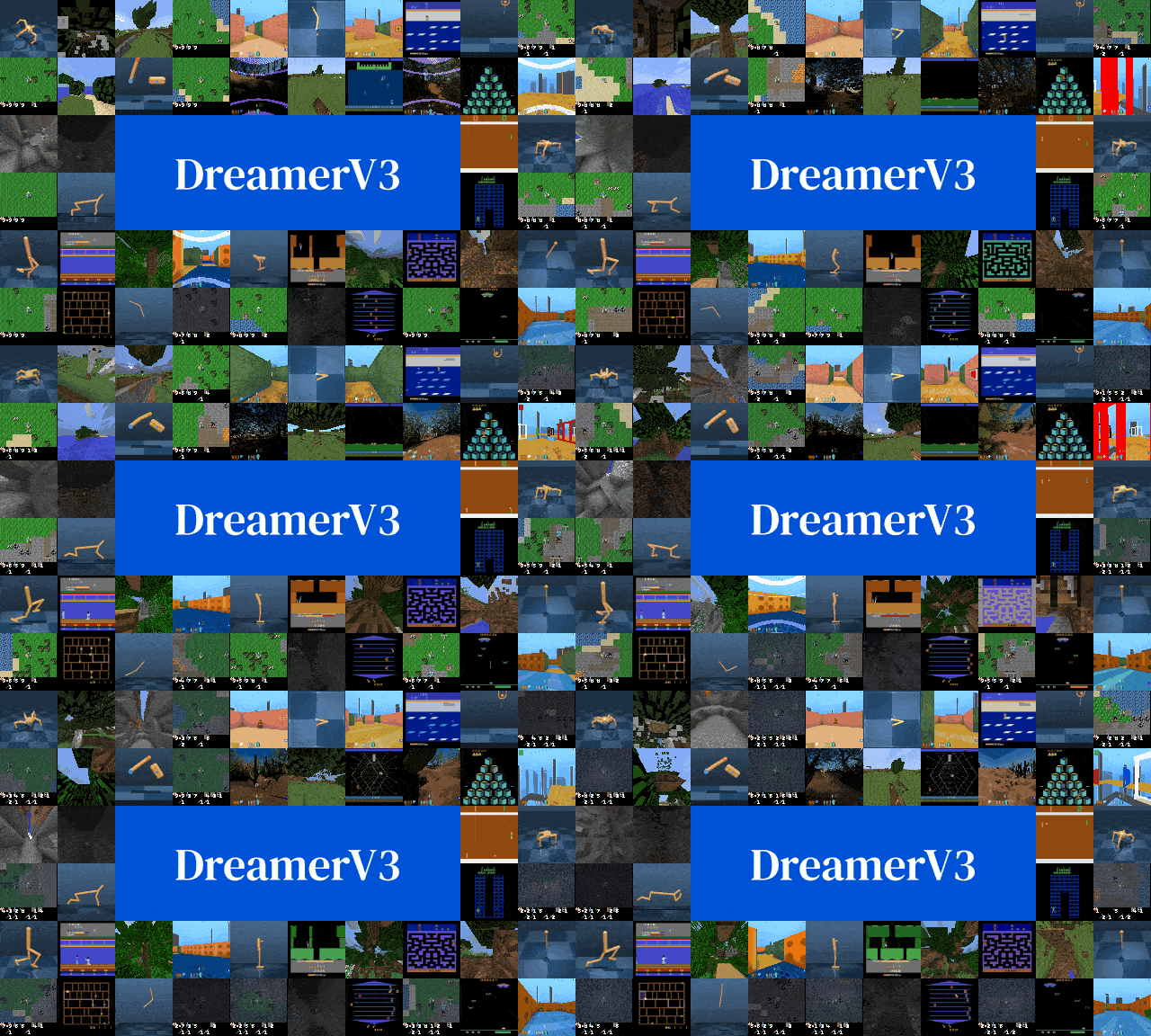
DreamerV3's central claim is that it doesn't need that. The same hyperparameters work across dramatically different domains - Atari games, Crafter, continuous control tasks, vision-based robotics. That's genuinely rare in the field.
It also scales smoothly. Bigger models perform better, which sounds obvious until you realize many algorithms hit a wall where additional compute stops helping. DreamerV3 scales with parameter count and dataset size more like a large language model than a typical RL algorithm.
When (and When Not) to Use This
Let's be direct: DreamerV3 is for ML researchers, game AI engineers, and people willing to invest time learning reinforcement learning from papers and code. You won't use it to optimize your server performance. Folks who try this won't use it to generate Minecraft worlds or manage player counts.
What you might use it for: training intelligent agents to navigate procedurally-generated environments, researching how world models learn from visual input, or understanding the gap between human intuition and machine learning approaches to games.
If you're setting up experimental servers to validate agent behavior, you could automate configuration with our Server Properties Generator. And if you're monitoring test servers during training runs, keep tabs on them with our Server Status Checker. But honestly, most of the work happens in simulated environments anyway.
Training time varies wildly. On GPU, expect 4-24 hours for usable models on Crafter. CPU training can stretch to weeks. You'll need to be comfortable reading Python, debugging JAX errors, and understanding config file structures.
Alternatives and Context
If you want a gentler introduction to reinforcement learning, Stable-Baselines3 is more accessible and better documented. OpenAI's Gymnasium is the standard for environment interfaces. If you want to work specifically with live Minecraft servers, community projects using the Minecraft API directly will be simpler, though less flexible.
Where DreamerV3 wins is pure generality. One algorithm, one codebase, one set of hyperparameters across radically different problems. For researchers and engineers asking "can we build a single learning algorithm that works everywhere?", this is an impressive answer.
danijar/dreamerv3 - MIT, ★3209
Lead writer at minecraft.how. Long-time Minecraft player running a small SMP server, testing every build, mod, and seed before writing about it.