Flower Forest Biome: Complete Guide to Loot, Mobs & Builds
The Flower Forest biome is one of Minecraft's most visually stunning locations, packed with rare flowers, tall trees, and surprising amounts of useful loot. If you're looking for a biome that's both beautiful and practical for building, this is where you'll want to set up camp.
What Is the Flower Forest Biome?
Flower Forests are essentially dense forests filled with every flower variant in the game. You'll find poppies, dandelions, tulips, lilies of the valley, blue orchids, and cornflowers all growing naturally alongside the trees. The biome generates lots of vegetation, which makes it feel almost overgrown compared to a regular forest. Rolling hills, tall oak and birch trees, and the occasional small pond round out the landscape.
It's a relatively peaceful place to set up initially. The dense coverage means plenty of shade and shelter options right from the start.
Where to Find Flower Forests
Flower Forests don't spawn everywhere. You're most likely to find them near regular forests, and they're fairly rare overall. If you're searching actively, you'll typically spot them within the first few thousand blocks of a spawn point, though luck plays a huge role. They generate more frequently in Java Edition 26.1.2 than in earlier versions, so if you're playing on the latest release, your odds are better.
The easiest way? Fly around in Creative mode first to scout the terrain.
Our seed library has 45 hand-tested seeds if you want to start somewhere with reliable biome access. Our community favorite right now is "Offshore Floating Village" (seed 118823198, 1.21), which spawns near some excellent biome variety. If you want guaranteed access to Flower Forests without hunting, a seed browser is honestly your best friend.
Loot and Resources You'll Find
This is where Flower Forests shine for early-game survival. Flowers are the obvious harvest, but here's the practical stuff:
- Flowers for dyes: Every flower type means every dye color is available nearby. This is massive for builders who want consistency without traveling.
- Wood: The abundance of tall oak and birch trees gives you tons of wood for tools, shelters, and early construction.
- Saplings: More trees mean more saplings. Perfect for replanting and maintaining a local wood supply.
- Tall grass and seagrass: These drop seeds, which you can use for early farming.
- Bee nests: Flower Forests attract bees, and naturally spawning nests give you early access to honey and honeycomb without finding a hive first. This is actually rare and valuable.
I tested this on my SMP server, and the flower availability alone cuts harvesting time in half compared to hunting across random biomes. You can gather every dye color within 100 blocks of your base.
Mobs That Spawn Here
Flower Forests aren't significantly different from regular forests for mob spawning, which is both good news and not-so-good news. Hostile mobs still spawn at night, so you'll need the standard precautions. However, the dense foliage actually helps: it provides natural cover if you need to hide or take shelter.
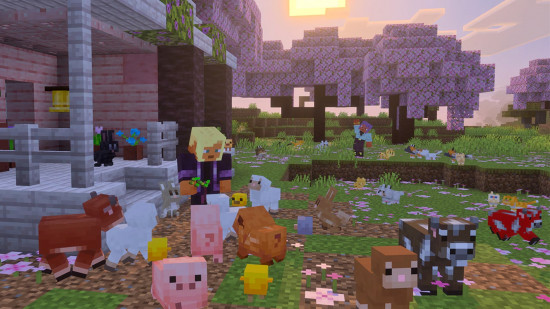
Passive mobs like sheep, cows, pigs, rabbits, and butterflies spawn frequently, especially with all the grass and vegetation. Look, bees are common too, thanks to the flowers. The occasional creeper still sneaks up on you (they always do), but overall the biome feels safer than a regular forest simply because there's more natural terrain to work with defensively.
Hostile mobs like skeletons and spiders can still ruin your day at night, so light up your builds and mining areas just like anywhere else.
Building Ideas and Inspiration
This is where things get fun. The natural aesthetic of Flower Forests makes them perfect for specific build styles:
Cottage cores and fantasy builds: All those flowers and towering trees scream fairy-tale vibes. Think cottages with flower gardens, stone pathways, and plenty of wood accents. The natural decoration saves you so much work.
Botanical gardens: Create dedicated garden spaces with flower beds and specimen trees. You've got half the materials already spawned around you. Add some stone paths, fences, and sculpted hedges, and you've got something really special. For skin inspiration when designing your character to match the aesthetic, check out our Browse Minecraft Skins gallery to find outfits that fit the fantasy theme.
Tall towers and treehouses: The height of the trees invites vertical builds. A tower nestled between trees, or a treehouse built into the canopy, feels way more natural here than forcing it in a flat biome. Actually, mixing both styles is where it gets interesting. A treehouse connected to a tower by bridges or vines feels like a legitimate fantasy outpost.
Practical resource outposts: If you're not feeling fancy, a simple warehouse for dyes, wood, and flowers works perfectly. The biome provides the materials, and you just need to build the storage and automation around it.
The challenge is that Flower Forests can feel cluttered. Clearing space for larger builds requires serious terraforming. Most players cut out a central area, flatten it, and build there, which leaves the natural chaos at the edges as a natural boundary.
Pro Tips for Thriving in Flower Forests
If you're planning to make a Flower Forest your home base, here's what actually matters:
Clear strategically. Don't clear everything. Remove just enough trees and flowers to see what you're doing, then build upward or downward. The remaining wilderness becomes part of your aesthetic.
Prioritize bee colonies. Protect the bees and hives if they spawn near your base. Honeycomb and honey are incredibly useful, and you won't find another colony spawn nearby. Harvestable resources like those are worth defending.
Plan water access early. Flower Forests usually have ponds, but they're scattered. Dig a well or build a water system early if you're not already near natural water sources. This matters for farming and general survival.
Use the Nether Portal Calculator for efficiency. If you're building a base in a Flower Forest and planning Nether travel, precision matters. Use our Nether Portal Calculator to line up your portals correctly so you don't waste time searching for your return portal.
Actually, that last point sounds obvious, but I've watched enough players fumble through portal math to know it saves real time.
Flower farms pay off. Set up crop farms for flowers. You'll have dye income without constantly harvesting, which frees you up for other projects. The biome provides seeds, but farming flowers specifically gives you reliable color supply.
Flower Forests aren't the most resource-rich biome overall, but for builders and players who care about aesthetics, they're genuinely one of the best starting areas. The combination of wood, flowers, bees, and natural beauty makes them practical and inspiring at the same time.

Lead writer at minecraft.how. Long-time Minecraft player running a small SMP server, testing every build, mod, and seed before writing about it.