HuskHomes: Why Your Server Needs This Teleportation Plugin
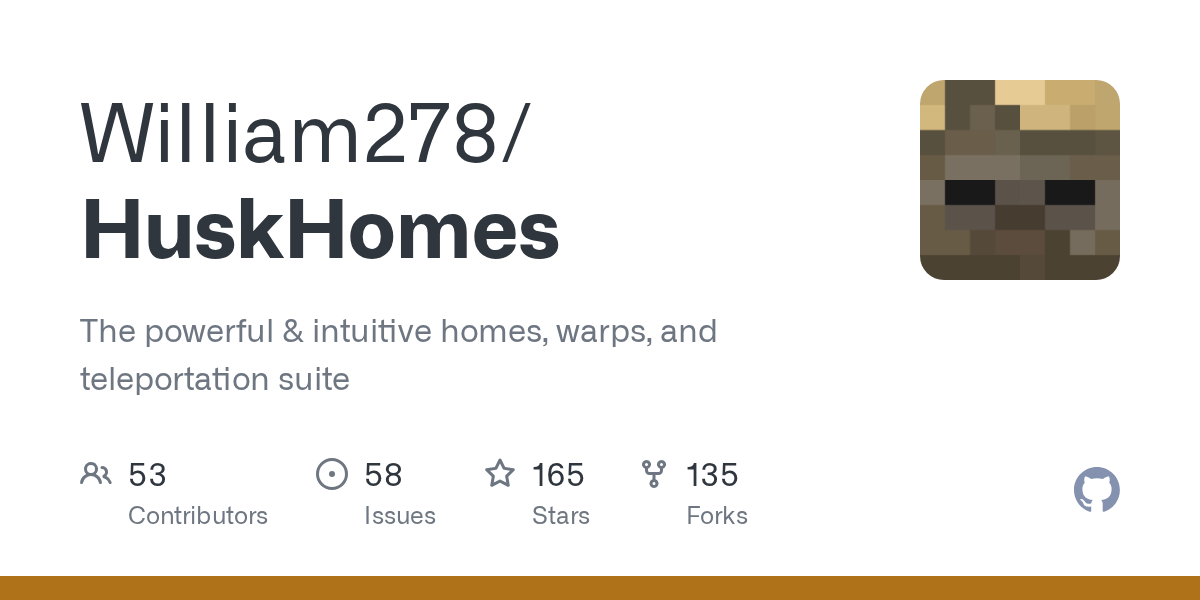
HuskHomes (WiIIiam278/HuskHomes)
The powerful & intuitive homes, warps, and teleportation suite
If you run a Minecraft server, you've probably watched players struggle with the same problem: how do I get back home without walking for twenty minutes? Or how do I remember where my friend's base is? HuskHomes solves these problems elegantly, giving your players (and admins) a full teleportation toolkit that actually gets out of the way.
What This Plugin Does
HuskHomes is a teleportation plugin for Minecraft: Java Edition servers. It handles homes, warps, teleport requests, and cross-server navigation. Think of it as the backbone of convenient travel on a server without resorting to overpowered commands or bloated GUI systems.
The plugin works on Spigot and Fabric servers. If you're running a network via BungeeCord or Velocity with a MySQL database backing it, HuskHomes can sync homes and warps across every server in your proxy. A player on Survival Server A can set a home on Creative Server B and teleport between them instantly.
You get standard commands like /sethome, /home, /warp, /tpa (teleport asking), and /rtp (random teleport). But there's nothing bloated about it.
Why You'd Use It
Minecraft players are lazy in the best way. They want to travel without friction, and they don't want to scroll through chest menus. HuskHomes respects that by using interactive chat menus instead of bulky GUIs. It's faster to click a link in chat than to open and search a chest inventory.
For a vanilla or near-vanilla server, this is essential. Players set a home at their base, maybe a second home at a shared farm or nether base. Warps let you designate server gathering spots (spawn, shopping district, PvP arena). Random teleport keeps people from hogging the same areas. On larger networks, cross-server homes mean you're not forcing players to use separate spawn hubs for each world.
Admins get tools too: move other players, delete problematic homes, teleport silently, set temporary bans on teleportation. It handles the edge cases that always come up.
Installation and Setup
For a single-server setup, drop the plugin JAR into your plugins folder and restart:
# Download from Modrinth or GitHub releases
# Then restart your server./restart.sh
# Or just restart in-game with /reload confirm
HuskHomes creates a config file on first run. If you're using a single-server SQLite setup (the default), it'll work immediately. Players can set homes right away.
For cross-server setups, configure the database section in config.yml to point at your MySQL/MariaDB instance. All servers in your network share the same database, so homes and warps sync automatically. You'll also need to set a cluster ID for each server so HuskHomes knows which server a player's teleporting to.
The actual configuration is reasonable. Most servers won't need to touch it beyond setting the database credentials and maybe enabling /rtp in the Nether (that's new in version 4.10).
Key Features That Matter
Public homes let players showcase their builds. Someone builds a beautiful house and wants visitors to see it? They can mark a home as public, and other players teleport there with /phome. It's community-building without needing a separate plugin.
Teleport requests exist for a reason. A player can't just teleport into your base uninvited. They ask with /tpa, and you accept or decline. It prevents griefing and respects privacy.
The random teleport command (/rtp) bumps a player to a random safe location. Useful for sending people exploring, preventing base-finding in early servers, or just giving people a fresh start. The latest release adds Nether support, which means you can have /rtp drop players safely in the Nether too instead of leaving them stranded or crashing them into lava.
Previous position teleporting. You died and got stuck? /back takes you to where you were before your last teleport. Not a full death waypoint, but useful.
API and extensibility matter if you're building something custom. Other plugins can hook into HuskHomes to add teleportation to their features. The codebase is clean and open-source (Apache 2.0), so if you find a bug or want to add something, pull requests are welcome.
Real Gotchas and Tips
The warmup timer sometimes didn't cancel if you took damage, especially in hectic PvP situations. Version 4.10 fixes that, so update if you're running an earlier release. You might also notice that same-server RTP wasn't working properly when cross-server RTP was enabled in older versions. Again, fixed in 4.10.
If you enable /rtp in the Nether, make sure you've updated the config. HuskHomes needs to know which blocks are safe to land on in lava biomes (it won't drop you in magma or lava lakes by default, but you can customize it).
One thing that trips people up: warps are server-wide, homes are personal. You can't have a "private warp" just for your friends. If you need that, use a separate home and share the coords with them, or make it a public home and trust they'll respect it.
On networks, always use the same HuskHomes version across all servers. Version mismatches can cause sync issues.
Similar Tools and Alternatives
EssentialsX does teleportation, but it's part of a massive plugin suite. If you only need homes and warps, HuskHomes is lighter and faster. If you're already using Essentials for shops, kits, and everything else, you might stick with it for consistency.
SimpleHome is simpler in scope (just personal homes, minimal config). It works, but it lacks warps, cross-server support, and admin features. Pick HuskHomes if you want room to grow.
WorldGuard has some teleportation features as part of region protection. Again, very different scope. HuskHomes is purpose-built for travel convenience.
If you're building a network, tools like Discord-based teleport bots exist, but they're clunky compared to in-game commands. Don't do that to yourself.
Before You Build
Consider whether you need cross-server support. If you're running a single server, SQLite is fine and requires zero database setup. If you're building a network, set up MySQL properly before you install the plugin (or migrate later, which is possible but annoying).
Test it on a test server first if you're nervous. It's stable and widely used, but you want to make sure the config makes sense for your setup before players start relying on /home.
Think about your admin policy. Honestly, will you allow players to set homes anywhere? On some servers, homes are restricted to certain zones or disallowed in the Nether entirely. HuskHomes lets you configure that per-world, so set those boundaries before launch.
Plan how many homes you'll let players have. Five homes is reasonable for most servers. Adjust it per rank if you've a permission system.
You can also integrate it with other tools. Plan has analytics hooks to show which homes are most popular. BlueMap and Dynmap can display homes and warps on your web map, which is genuinely cool for showing players what's around.
If you're running something like a voting plugin (and have setup issues to debug), you might find our Votifier Tester useful for troubleshooting. Similarly, if you're setting up your server's MOTD, the Minecraft MOTD Creator is a handy companion tool for testing those quick server messages.
Visit WiIIiam278/HuskHomes on GitHub ↗
Lead writer at minecraft.how. Long-time Minecraft player running a small SMP server, testing every build, mod, and seed before writing about it.