Obsidian in Minecraft: Complete Guide to Mining and Uses
Obsidian is one of Minecraft's most iconic blocks. And this jet-black, glass-like material has defined the game since the early days, standing as the primary building block for Nether portals and a go-to for players who want something that looks genuinely imposing and permanent.
What Is Obsidian and Where to Find It
Obsidian forms when lava meets flowing water. That's the fundamental rule. You'll find it naturally in the Nether, where lava pools are everywhere, but it also spawns in the Overworld near caves and underwater areas where lava sources meet water flows.
Most players, though, don't wait to stumble upon natural deposits. They make their own. Get a water bucket, find a lava source block, and pour water over it. Done. This is how every survival player starts their journey to the Nether. It's simple, it's reliable, and it beats exploring for hours hoping to find the stuff naturally.
The abundance of lava in the Nether means you can create massive quantities of obsidian if you're patient enough. In the Overworld, look for deposits near cave systems, especially around sea level or in cavern networks where lava has cooled.
How to Mine Obsidian: Tools and Techniques
Here's where things get specific: you need a diamond or netherite pickaxe. Anything less and you're wasting your time. Wooden, stone, iron tools? They won't break it. I've watched newer players spend actual minutes trying to mine a single obsidian block with an iron pickaxe, and it's honestly painful to witness.
Netherite is faster (about 7 seconds per block) if you've got it, but diamond works perfectly fine (about 9.4 seconds per block). Standard mining times matter more than you'd think when you're surrounded by lava. Efficiency enchantments help tremendously: Efficiency IV or V on your pickaxe cuts mining time significantly and makes the whole process less stressful.
One thing that trips people up: obsidian is heavy. You can only carry a stack of 64 blocks, and they take up meaningful weight when you're moving through tight spaces or swimming. Plan your inventory accordingly if you're doing a large mining run.
Pro tips for efficient obsidian mining:
- Bring a full set of diamond tools with backup pickaxes (tools break)
- Use water buckets to create obsidian on demand instead of hunting for natural deposits
- Set up a small, controlled lava-water system at your base rather than mining in dangerous environments
- Bring containers. You'll fill your inventory fast with this dense material
- Use Efficiency V enchanted pickaxes for the fastest mining times available
Building and Decorating with Obsidian
Obsidian looks incredible in builds. The dark texture contrasts beautifully with lighter materials like purpur blocks, white concrete, or gold blocks. I've seen obsidian used for everything from modern house frames to entire tower structures.
The block's aesthetic appeal comes from its texture and deep purple-black color. It photographs well in screenshots. Builds that feature obsidian tend to read as more polished, more intentional than surrounding structures. But here's the catch: it's mostly decorative for builders. As a structural material, it doesn't add mechanical benefits the way blast-resistant blocks like reinforced deepslate do.
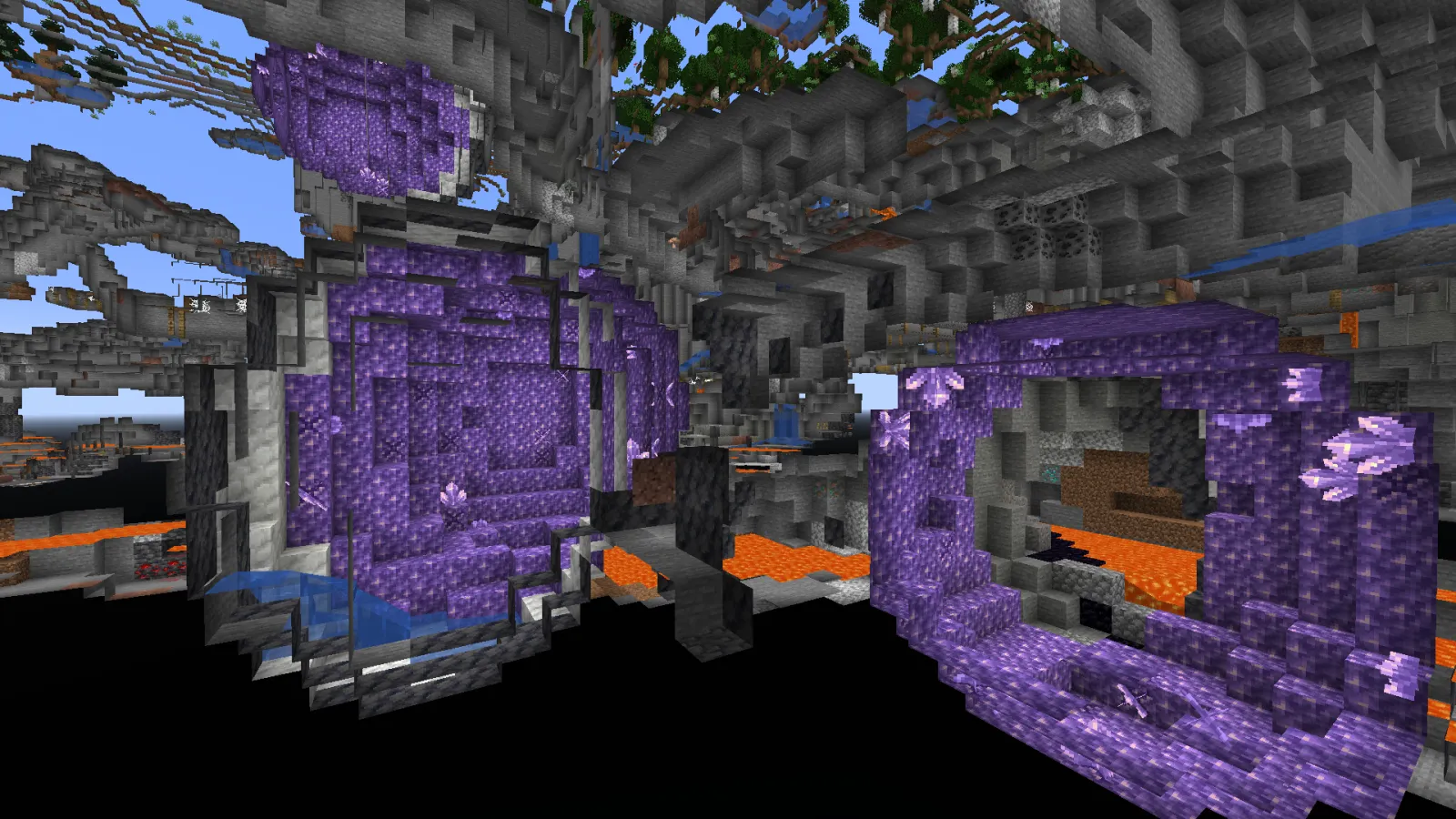
For creative builds, obsidian shines in contrast. Use it as window frames, pillars, or accent walls paired with gold or amethyst. The 3D depth in the texture means it looks good at a distance, making it perfect for large-scale projects. Ever tried building a full castle entrance with vanilla blocks? Obsidian pillars solve that immediately.
If you're planning designs with text or custom layouts using obsidian, our Minecraft Text Generator can help you map out patterns and spacing before you start placing blocks. For comparing obsidian with other dark blocks and finding alternatives that might suit your build better, our Minecraft Block Search tool lets you filter by color, texture, and material type.
Creating Nether Portals with Obsidian
This is obsidian's primary function, and honestly, it's the reason obsidian exists in the game's design. You need at least 10 blocks to frame a functional Nether portal (minimum 4 blocks wide, 5 blocks tall for the opening). Most players build the standard 4x5 frame, which requires exactly 14 blocks arranged in a rectangle.
The portal activates with flint and steel once the frame is complete. No portals spawn naturally in Minecraft, so you've to build every single one yourself. This resource requirement creates an interesting early-game bottleneck. Finding enough obsidian slows down your first Nether trip, which is exactly the pacing Mojang intended.
Once your portal is set up, it's permanent until you deliberately break it (which requires a pickaxe, obviously). You can create multiple portals in different locations, linking the Nether and Overworld together. Building your portal near your base is a common strategy, but experienced players often build secondary portals near specific Nether locations (like bastion remnants or nether fortresses) to save travel time.
Portal frames don't have to be just purple and black. With colored concrete and wool, you can build decorative structures around your portals to make them feel intentional and part of your base design rather than purely functional.
Obsidian vs. Other Dark Blocks
You might wonder why obsidian when other options exist.
For portals, there's literally no alternative. Obsidian is mandatory. No other block works. This is by design, not a limitation.
For building, obsidian competes with blocks like deepslate, blackstone, and dark prismarine. Deepslate is arguably more versatile for modern builds because it has variants (deepslate bricks, polished deepslate, chiseled deepslate, etc.). Blackstone is similar to obsidian aesthetically but slightly more textured. Dark prismarine has an aquatic feel that works better with water features.
Actually, let me correct that: obsidian doesn't have variants. It's just one solid, unchanging block. That limitation is kind of its strength, weirdly. It commits to being flat and featureless, which works for certain builds and completely fails for others. If you want detail and texture, obsidian isn't your answer. Here's the thing, if you want pure, uncompromising darkness, obsidian is the only choice.
The decision comes down to your build's style. Modern builds with clean lines? Deepslate probably works better. Gothic or dark fantasy? Obsidian. Medieval? Blackstone. Aquatic structures? Dark prismarine. Each block tells a different story.
Obsidian in Minecraft 26.1.2
In the current version of Minecraft Java Edition (26.1.2), obsidian behaves exactly as it has for years. Mojang hasn't made changes to obsidian's properties, mining requirements, or crafting recipes recently. It remains one of the most stable, predictable blocks in the game.
The only significant thing to know is that obsidian can't be moved by pistons. It's immovable and permanent, making it ideal for structures you never want to change. Some players use this property to create permanent walls or dividers in multiplayer servers.
If you're playing on older versions or different editions (Bedrock, mobile, console), obsidian works identically. It's one of the few blocks that's genuinely universal across all Minecraft versions.

Lead writer at minecraft.how. Long-time Minecraft player running a small SMP server, testing every build, mod, and seed before writing about it.
Domande frequenti
Can you mine obsidian with an iron pickaxe?
How many obsidian blocks do you need for a Nether portal?
Can obsidian be pushed by pistons?
What's the fastest way to create obsidian?
Is obsidian used for anything besides Nether portals?
Have a Question or Tip about this Guide?Community Q&A
Ask a question or help other players below. Join the discussion and share your Minecraft tips!
Commenti
Ancora nessun commento. Sii il primo a condividere la tua opinione!