Complete Minecraft Crafting Guide: Recipes, Tools, and Tips for 2026

Crafting is the backbone of Minecraft, and mastering it separates players who build proper bases from those stuck in survival mode with iron pickaxes that break every five minutes. This guide covers everything you need to craft like a pro, from basic recipes to advanced strategies most players never bother learning.
The Crafting Grid Basics
Your first crafting table is the most important tool you'll ever make. You start with a 2x2 inventory grid, which is genuinely limiting once you realize it (that's basically eight slots of total crafting space). The full 3x3 crafting table multiplies your possibilities dramatically and, unlike your inventory, it doesn't care about item slots.
Every recipe follows a pattern. Minecraft doesn't randomize crafting, so once you learn the layout for a wooden pickaxe, you've got it forever. The grid respects rotation in some cases, but not all, which honestly used to confuse me on my first Bedrock server before I realized the wiki has patterns for literally everything.
Two things matter when you sit at a table.
First, exact placement. A sword requires two materials in a vertical line. A chest needs eight wood blocks surrounding an empty center. There's no guessing. Second, material type. Five oak planks won't make anything a birch planks would. This sounds obvious until you're mining at 2 AM and grab the wrong wood from your storage system.
Essential Tools and Workstations
Crafting tables are the foundation, but they're just the start. A furnace smelts raw materials into usable forms. An enchanting table + bookshelves upgrades your gear. A smithing table upgrades tools with netherite. An anvil repairs items and combines enchantments (costing way too much experience, but it's the only way to get Unbreaking III on your pickaxe).

Here's the actual progression most efficient players follow: collect wood, build a crafting table, gather stone, make a stone furnace and pickaxe, mine iron. Once you're in iron gear, you can comfortably reach diamonds. After that, netherite is achievable if you're willing to go deep and deal with the Nether.
If you want to look the part while you're mastering these tools, the CraftingElephant Minecraft Skin is genuinely charming and keeps the crafting aesthetic front and center. For those wanting something more minimalist, the _crafting_table_ Minecraft Skin makes your character basically a walking workbench.
Recipes That Matter
You don't need to memorize every recipe in the game (thank goodness, because there are hundreds). Focus on what keeps you alive and building.
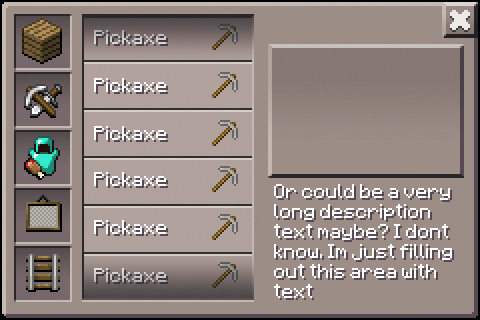
- Tools: pickaxe, axe, shovel, hoe in that priority order
- Weapons: sword first, bow second once you find arrows
- Armor: boots and pants before chestplate, helmet last (it's the weakest protection)
- Basics: sticks, planks, chests, doors, beds, furnaces
- Advanced: hoppers, pistons, repeaters, comparators for redstone projects
The crafting recipe for a pickaxe is three blocks of material on top, two sticks below them vertically. This pattern works for every pickaxe: wood, stone, iron, diamond, netherite. Same with swords: two blocks vertical, one stick below. Once you learn the shape, you've learned them all.
Your furnace burns fuel and converts raw ore into ingots.
But here's where people waste resources: they burn dirt. Use wood scraps, saplings, or kelp instead. Coal is precious and should be saved for long journeys or smelting in bulk. Some players hoard coal like it's going out of style, then never actually mine at scale to need it.
Advanced Crafting Strategies
The best players think three steps ahead. Before you craft that armor, do you've enough ore to make it worthwhile? Before you craft a pickaxe, do you know what you're mining for? Impulsive crafting wastes materials fast.
Automatic farms are where crafting strategy gets interesting. You can automate wood collection with pistons and a sapling farm, automate stone generation with lava and water, automate smelting with furnaces fed by hoppers. These setups save hours because you're not sitting at a furnace watching ore turn into ingots.
The crafting_cricket Minecraft Skin captures the energy of someone who's actually done this kind of mechanical thinking, and honestly, if you're spending hours on redstone contraptions, you might as well look the part. For those who want a softer aesthetic, the craftingrek Minecraft Skin works beautifully.
Enchanting changes everything. A diamond pickaxe is good. A diamond pickaxe with Efficiency V and Unbreaking III is exponentially better. Craft bookshelves (a wood frame with three books) around an enchanting table to increase your enchantment levels. Higher levels unlock better enchantments and higher tiers of existing ones.
Actually, let me correct that slightly: bookshelves don't increase the level number you see when you hover over items, but they do unlock access to stronger enchantments you couldn't get otherwise. It's a bit confusing the first time you play with proper enchantment setups.
Common Mistakes Beginners Make
Burning tools and armor in lava when you die is preventable. Keep your valuables in a secure chest, not on your hotbar. When you're deep mining and hit lava, don't panic-click. Walk back up.
Using stone and iron tools too long is another waste. Upgrade to iron the moment you can mine it. The speed difference is huge and will save you enormous amounts of time over a playthrough. Similarly, don't craft full iron armor until you actually need it, but do craft a helmet and chest once you've eight ingots because creepers hit harder than you'd think.
Furnaces are inefficient for large-scale smelting.
If you're smelting a stack of ore, you're losing ticks of fuel and time. Use multiple furnaces instead, or better yet, set up hoppers and a hopper farm so the smelting happens continuously. The crafting Minecraft Skin has the vibe of someone who's probably figured this out already.
Never throw away your old gear. Combine it at an anvil to repair it, or dismantle it in a grindstone if it's too expensive to repair. Grindstones destroy enchantments but give experience back, which can be used on another anvil repair.
Building With Crafted Materials
Your crafted items are building blocks, literally. A stone slab, stair, or wall offers more visual variety than plain stone. Crafting these variations takes the same base material but gives you control over aesthetics. Barrels, beehives, cartography tables, and crafting tables themselves all work as decorative elements if placed strategically.
Redstone dust crafted from raw redstone opens up automation. Pistons move blocks. Observers detect changes. Comparators and repeaters do timing and logic. You don't need to understand all of this to play Minecraft, but once you craft your first simple contraption (like an automatic door), you'll understand why it's addictive.
Crafting is how Minecraft becomes a game you shape.
Everything from shelter to weapons to automation starts at a crafting table. Master the basics, learn to recognize recipe patterns, and you'll stop being reactive ("I need a pickaxe right now") and start being intentional ("I'll gather these materials, then plan my next project"). That shift is when Minecraft clicks.